
Classic men’s watchesMen's
Classic women’s watchesWomen's
SmartwatchesSmart
Brands
Other
15.1.2026 | 12 MIN
Sapphire crystal, new running metrics, and a display that puts the midday sun to shame. Forerunner 970 isn’t a revolution — but it’s exactly the kind of upgrade that makes you go, “Yeah, this really makes sense.”

I’ll admit it up front — the Garmin Forerunner won me over. And I’ve got a few reasons why. I’m a runner, I have a soft spot for things with a sensible (I’ll explain) price tag, and I get excited when a brand brings features we haven’t seen before. But that’s my personal take. Now let’s look at what objectively stands out on the Forerunner 970:
Combined with the brand-new HRM-600 chest strap, it also unlocks running features we haven’t had before, such as running economy and step speed loss.

Sapphire. That’s probably the hottest design talking point of the Forerunner 970. Although mineral glass is more impact-resistant and produces slightly fewer reflections, sapphire is still considered more premium. It’s virtually scratch-proof — and apart from sapphire or diamond, basically nothing will scratch it. Sure, there will always be someone clever enough to scratch the unscratchable. But I’ve had hundreds of watches on my wrist and honestly — I haven’t managed it yet.

The other big new thing for me is the LED flashlight, which has become hugely popular among Garmin users in recent years. Why? Because it’s genuinely useful. Think how many times you’ve needed a light. A trip to the bathroom, safety on the road, showing off to your friends... Plenty of moments. Just double-press the LIGHT button.

Since we’re on buttons — for anyone new to Garmin, there are five on the case. The lower left and middle left are for scrolling up and down, the upper left wakes the display. The upper right confirms, the lower right takes you back one step.
The color options are, just like the previous FR 965 generation, three. Back then it was black and white — which stay — and this year yellow is replaced by beige with a gold bezel. Let’s be honest, this combo isn’t the most masculine. So it’s fairly clear who it’s aimed at.
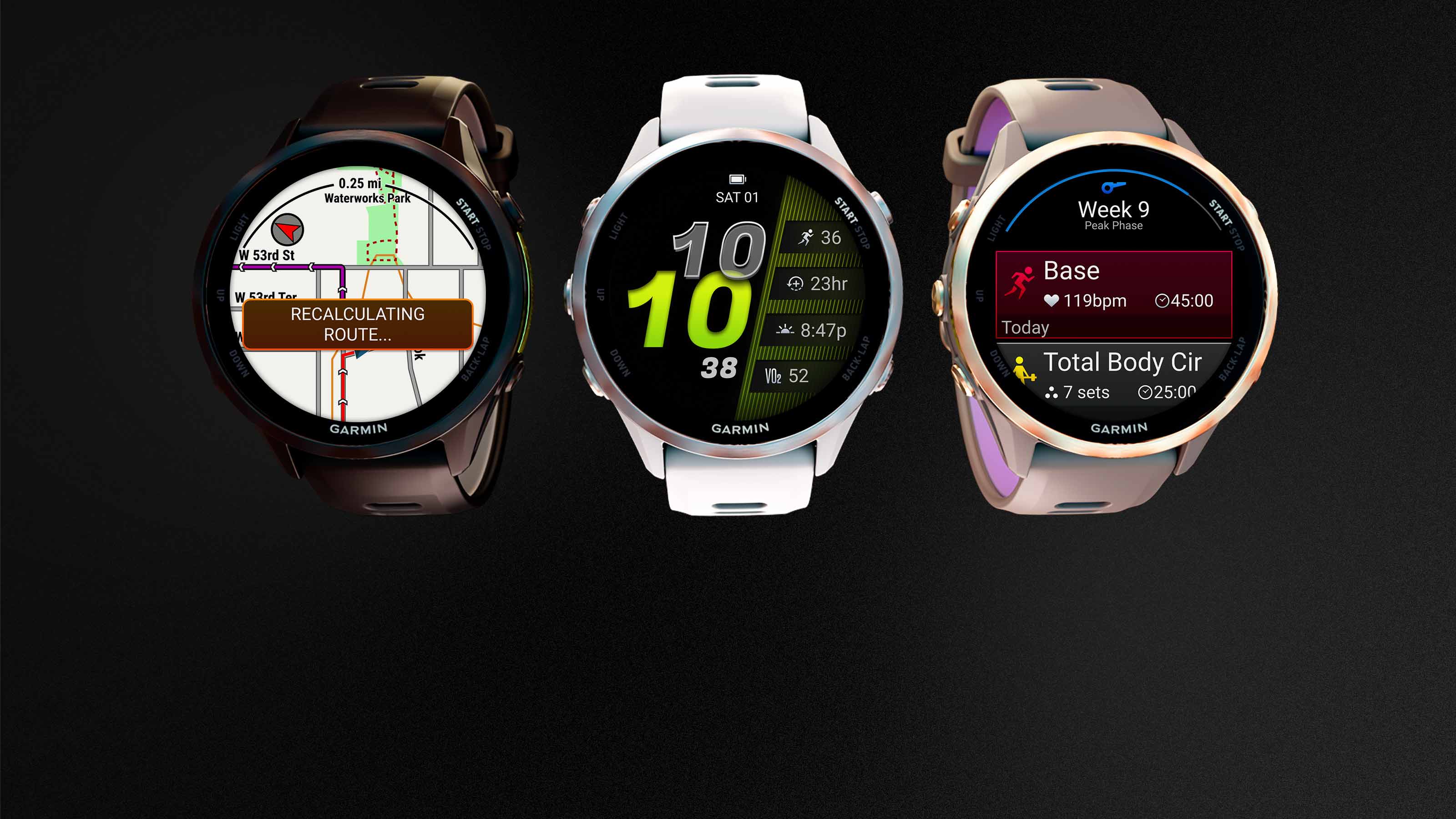
The case measures 47 × 47 × 12.9 mm and weighs 56 grams. It’s made from a mix of plastic (the watch body) and titanium (the bezel). Personally, I wouldn’t go for the white variant — the absence of a DLC coating doesn’t protect the bezel enough against scratches. That’s where the black and beige versions have a big advantage.
The 22 mm strap is secured with a thick fixed spring bar — not with QuickFit or QuickRelease. Eyebrows have been raised at this mounting choice for years, but the reason is probably simple: Garmin is aiming at the triathlon world. And if you’ve ever seen a triathlon start, you know it’s more of a watery free-for-all. That’s exactly where one of the most secure attachments comes in handy.
Forerunner 970 is still compatible with QuickFit straps, though. Just remove the spring bar, slide it out, put it back in — and you can snap on any QuickFit. Or thread a nylon strap under the spring bar.
It’s also worth mentioning that while the Forerunner 970 may look a bit like a Fenix, spec-wise it’s far from it. Water resistance is 5 ATM (while a Fenix handles a real depth of 40 meters), the buttons are classic mechanical ones, not inductive, and the Forerunner doesn’t meet any military durability standard. On the other hand — the Forerunner is primarily built for road racing and triathlons. Garmin has other models for the outdoors. :)

16.1.2026
Garmin Fenix 8 review – Daddy’s home
Garmin did it again — they released something new and once more didn’t say how many nits the display actually puts out. Online estimates float between 1500–2000 nits, but there’s no official confirmation. What matters more: it really is brighter. Everyone who sees the watch immediately says the display is noticeably brighter than on other Garmins.

The AMOLED display measures 1.4" with a resolution of 454 × 454 pixels.
Of course, you can enable Always-On so the display never fully turns off, but it’s debatable whether to use it. The new generation has slightly shorter battery life, and this display setting will cost you a substantial chunk of days.
The user interface is more or less unchanged. It’s a bit of a shame Garmin didn’t make a tradition of it — I vividly remember a major UI shift arriving with the Forerunner 265 and 965. The Fenix 8 series reinforced it and the Forerunner 970 continues in the same vein.
On the main screen, swipe down for the notification center, swipe up to scroll through widgets. The upper right button opens the app and activity picker, while the upper left opens shortcuts — you’ll find watch modes, Find My Phone, and more.
If Garmin used to have one problem, it was that everything was kind of everywhere. A bit like walking into Lidl looking for beans, only to find they’re not by the canned goods — they’re in that middle aisle because it’s camping week.
Now all health data lives under Health, sports data under Training, and apps and sports profiles are separated. In short: you can actually find your way around. But that applies to all newly released Garmins now.

I honestly can’t remember the last time I wrote in a Garmin smartwatch review that battery life had decreased. But compared to the Forerunner 965, which lasted 23 days in smartwatch mode, we’re now at about 15. Let’s face it — that’s still plenty. But shaving off eight days? That’s a lot as well.
As for GPS modes, I’d rather put it in a table. It’s a bit of a mixed bag. Shorter here, longer there...
| FR 955 | FR 965 | FR 970 | |
| In smartwatch mode | 15 days | 23 days | 15 days |
| GPS only | 42 h | 31 h | 26 h |
| Multi-GNSS + SatIQ | - | 22 h | 23 h |
| Multi-GNSS (multi-frequency) | 20 h | 19 h | 21 h |
| Multi-frequency + music | 8.5 h | 8.5 h | 12 h |
If I had to draw a line, for me personally it’s five days. Anything under five doesn’t really appeal to me as an athlete. That’s why I can’t do Apple Watch. But if we’re talking fifteen days, I’m still fine with it. In reality, I get about a week — and I don’t use Always-On. A bright display, lots of activities... That’s going to show on the battery.
I don’t want to sound like an old-timer in this review, but I’ll reminisce again. A year ago we launched an interesting project — we tested GPS and heart-rate measurement accuracy. And if any model was controversial, it was the Forerunner 965. In the GPS accuracy test, it actually came out best of all.
But setting aside the miles (in this case rather beats) separating the Suunto Race, the Forerunner 965 actually did the worst in heart-rate accuracy. We weren’t the only ones who noticed poor readings — the community did, too. Ironically, other watches with the same heart-rate sensor didn’t measure badly at all. The Forerunner 265 is even the provisional winner.
Garmin has always been good at GPS:

Purple — Garmin Forerunner 970, blue — Huawei Watch Fit 4 PRO
I consider these two sensors the most critical in a sports watch. But you’ll also find others: accelerometer, barometer, compass, gyroscope, thermometer... And the optical sensor (besides heart rate) measures blood oxygen, skin temperature, and can even take an ECG recording.

If anything sets Garmin apart from other smart sports watches, it’s the breadth of health and smart features. I’ll start with health — and as usual, I’m ranking them by my own priorities. :)
Heart rate variability. This is something the competition is also leaning into more and more. It’s a golden metric — it reveals a lot about recovery, stress, or even an oncoming illness. In short: it tracks the time interval between individual heartbeats. The greater the variability (i.e., longer time differences), the better. It means your parasympathetic nervous system — associated with relaxation — is dominant.
Sleep tracking. I wouldn’t say Garmin is the best here — personally, I’d highlight Polar or Amazfit. But at the very least, it’s solid and, most importantly, reliable. I don’t get false detections of sleep when I wasn’t sleeping — or the other way around. You see the timing of each stage, an overall sleep score (0 to 100), and a so-called sleep coach recommends how much sleep you need the following night based on stress, load, and other factors.
Nap tracking. A relatively new addition. It doesn’t break naps into stages, but it does measure the duration. And importantly — the coach factors this time into your overall sleep need.
All Garmins also measure breathing rate, heart rate, and stress every second. Stress, in particular, heavily influences Body Battery — the indicator that shows how “charged” your body is on a scale from 0 to 100. Stress, poor sleep, and of course exercise all drain it significantly.

And from the usual stuff everyone asks about... Yes, it counts steps, calories burned, and you can create challenges with friends.
Looking around my circle, I hardly know anyone with a Garmin who doesn’t tap through the Morning Report right after waking up. It tells you about last night’s sleep quality, the daily suggested workout, calendar events, weather — and wraps it all up with a motivational quote.
Similarly, you’re now greeted by an Evening Report. You can review your training stats for the day, recovery time, training status, Body Battery, the next day’s planned workout, the weather forecast, and recommendations from the sleep coach.
The headline above isn’t mine — it’s from Garmin’s official pages.
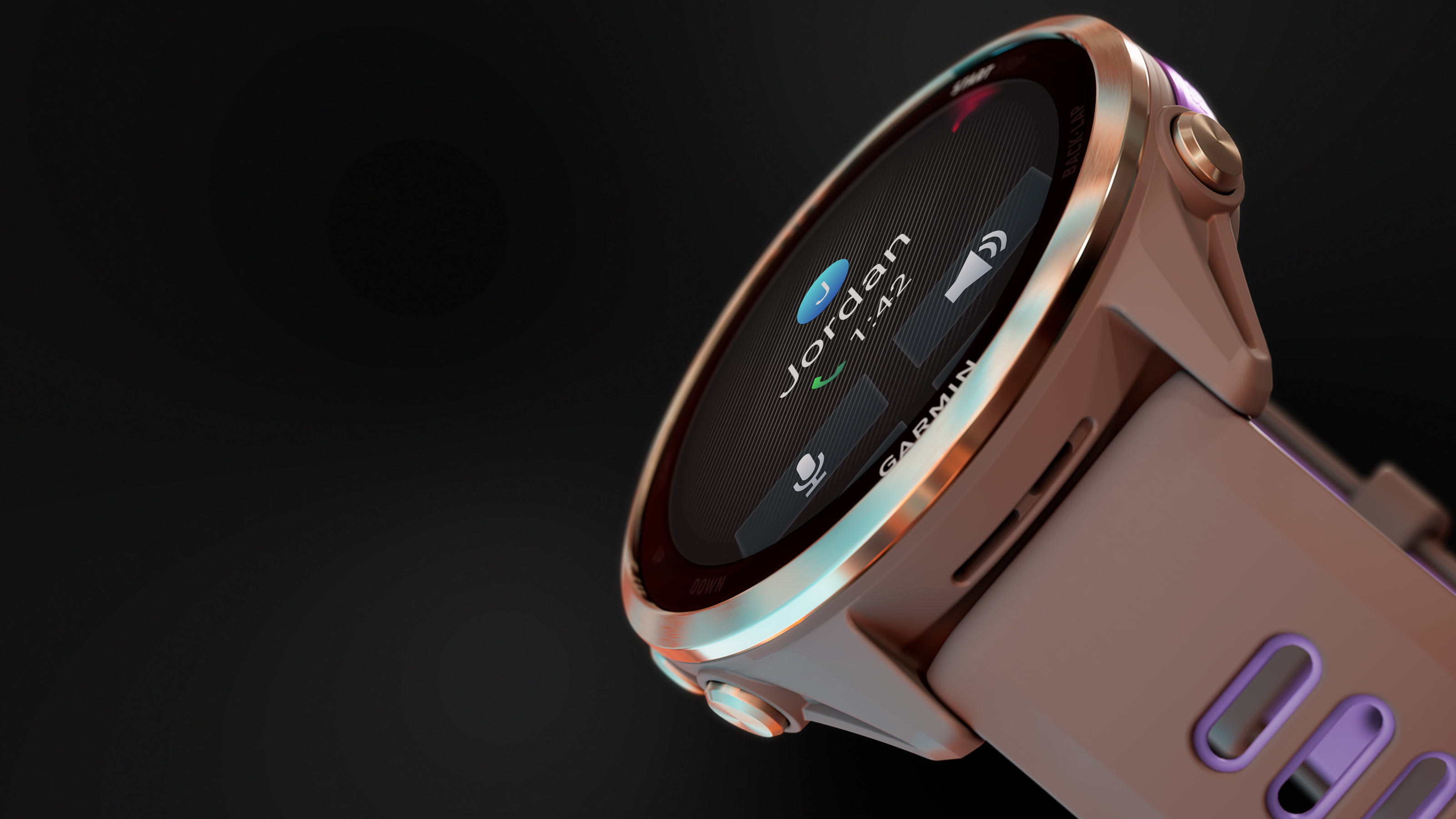
I actually find it pretty funny to promote new calling capability by showing how you can more conveniently say you can’t take a call. :)
In terms of smart features, the biggest step forward is definitely calling and the addition of a voice assistant. If your phone is within Bluetooth range, you can handle calls right from your wrist.
On top of that, the watch supports Garmin Pay and a music player with access to streaming services.
The watch also mirrors all notifications from your phone, and Android users additionally get the option to reply with preset responses.
Athletes will certainly appreciate navigation and maps, with Garmin arguably the only brand rendering them in such detail that you can even see color trail markings. For me, that’s a crucial navigation element in the mountains.
Straddling the line between sport and smart features, you’ll find PacePro and ClimbPro — smart on-route guidance I’ll get into below.
This is the section I was most excited about, because there’s a lot of new stuff here — and features that define the Forerunner 970.
First up, the novelties you get only in combination with the HRM 600 chest strap. Beyond finally being detachable and rechargeable, it helps the new Forerunner with two metrics.
The first is step speed loss, which measures the loss of speed with each step. This metric is expressed in centimeters, uses a fixed point on your chest, and in short records your body’s braking.

From that first function comes running economy evaluation, shown on a dedicated scale. Theoretically, running economy was already inferred from vertical ratio before, but I’d make the same argument — the new feature is more straightforward.
It occurs to me that while vertical ratio derives from vertical oscillation, step speed loss makes more sense: you can have low vertical oscillation and still be uneconomical, because you spend unnecessarily long on the ground with each foot strike.
What might excite me even more is Running Tolerance.
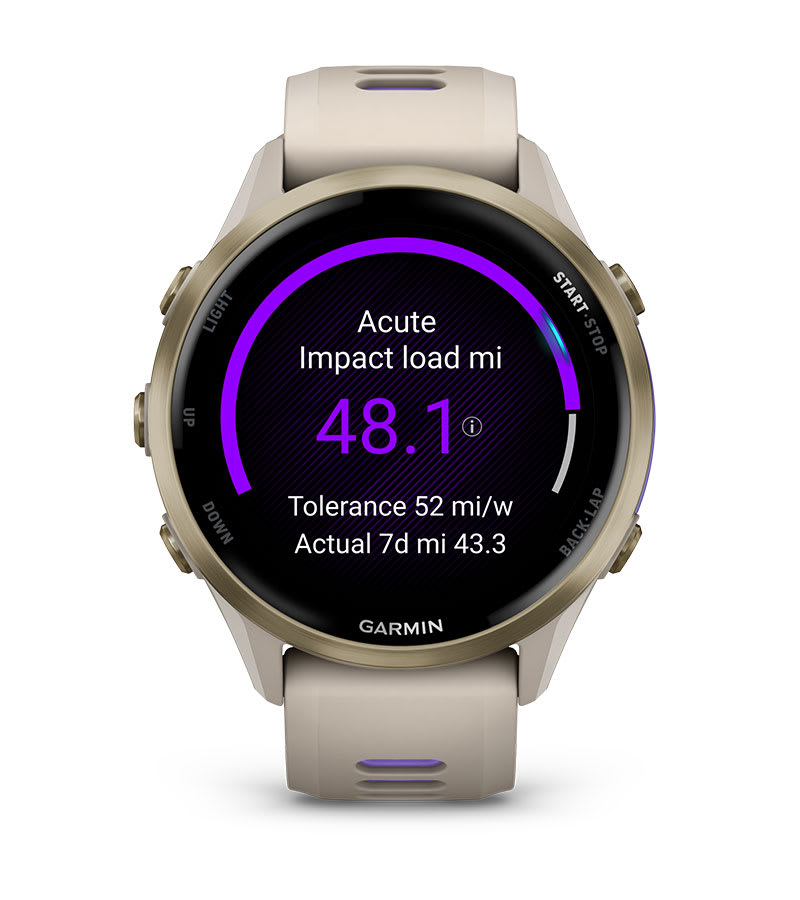
This feature teaches you to understand training blocks. While weekly mileage is one of the most straightforward metrics, recent years have seen sessions expressed more in hours and minutes. A kilometer isn’t always a kilometer, but an hour is always an hour. When was the last time someone asked you — how many hours a week do you run?
Running Tolerance teaches you that a 10K isn’t always the same 10K. Based on your training history and fitness, Garmins estimate your ideal weekly mileage. But they also factor in intensity and elevation gain into each run’s “distance.” Garmin calls this Load Impact. So if you do a hilly 10K, your Running Tolerance might not add 10 kilometers, but say 16, because it was a tougher 10K.
You could argue training load does something similar, but it’s nowhere near as straightforward as Running Tolerance.
There are plenty of other niceties. I was pleased to see Auto Lap now works with time gates. Mark a gate on a loaded course — and the watch will automatically record a lap the moment you pass it.
Another new one? Finally, no more finish-line photos of someone stopping their activity! The new feature alerts you when you complete a loaded course and directly suggests stopping the activity. You might say: “What’s the point? My watch already says ‘Course completed’.” But here’s the kicker — this feature can also automatically “trim” the activity. So if there’s a round of applause after you finish and then you head straight to the nearest pub, your activity’s end won’t suffer.
Predicted finish times for 5K, 10K, half marathon, and marathon got an upgrade, too. They no longer rely solely on VO₂ Max, but take your entire training history into account — so times can change dynamically. You can also enter a target race date. The watch will then estimate how fast you’d likely run it on that day and offer tips on what to tweak for the best result.
Given triathlon’s growing popularity, many will welcome adaptive triathlon training plans, where the watch tells you what to train each day.

Let’s also go over what remains — and still works. Based on training load, the watch can tell you whether your training is productive. In addition, every day it evaluates on a scale of 0 to 100 how ready you are to train. It takes into account sleep history, last night’s sleep, stress history, HRV balance, recovery time, and overall training load. All these numbers go into the calculation — and the result is a single number: Training Readiness.
Beginners will definitely appreciate Daily Suggested Workouts. They pop up whenever you open a sport profile (run, ride, swim, triathlon), and you’ll also find them in the Morning or Evening Report.
Alternatively, you can reach for predefined Garmin Coach plans. They span various sports, with the strongest focus on running, cycling, and swimming.
Whatever you do, you get full post-workout analysis: pace or speed, distance, elevation, heart rate, calories burned, and more. Runners also get GAP and Running Dynamics.
Cyclists get MTB dynamics — measuring flow and jumps. And if you add the right accessories (and it’s not a cheap setup), you’ll also see power in watts.
My feelings were probably obvious throughout this article. I simply like it. There’s a bunch of new running features — and that always makes me happy.
Plus, the Forerunner 970 got more premium glass, a better design, and calling. That last one doesn’t do much for me personally, but I’m sure plenty of people will appreciate it. :)
One small blemish? Some features only work with the chest strap — which, by the way, is pricier than the entire Forerunner 55. Right now it’s around €160, which isn’t exactly little. On the other hand — compare the price to a Fenix and you’ll still have room left over to invest in the strap.
How about you? Would these watches be worth lightening your wallet?
Photo sources:


