
Classic men’s watchesMen's
Classic women’s watchesWomen's
SmartwatchesSmart
Brands
Other
16.1.2026 | 12 MIN
Yes, after a long wait it’s finally here — and smart sports watch enthusiasts have been waiting for it: the Garmin Fenix 8. It borrows a bit from Epix, a bit from Descent, and a bit from the world of mainstream smartwatches. And very likely (you could even say inevitably), it takes the top spot again among smart sports watches. But let’s be honest… didn’t we all kind of expect that?

The most interesting new features in the eighth-gen Fenix:
In 2025, the Fenix 8 Pro variant with LTE support was added.

24.1.2026
Garmin Fenix 8 Pro / MicroLED – LTE support and the world’s brightest display?
Even if the Fenix 8 could do far less than it actually can, it would still be in huge demand, because let’s admit it, these watches look fantastic…
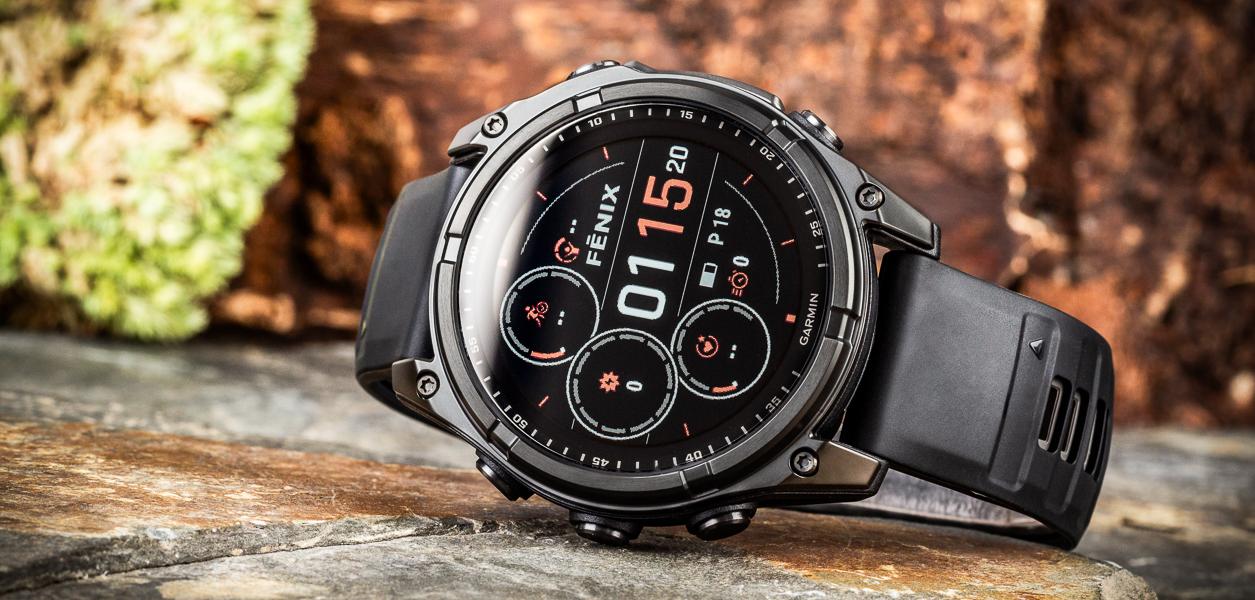
The bezel got slimmer, the button labels are gone, the iconic markers around the dial are more pronounced, the lugs have sharper machining, and suddenly the Fenix 8 has a cleaner yet sharper design with a touch of edge.

Fenix 7 was iconic for its colorful guard around the START/STOP button, but the Fenix 8 doesn’t have anything like that, apart from more pronounced protection on the right side, doesn’t have anything like that. Honestly, I don’t mind at all, because the watch feels simply elegant, which mirrors its much bigger reach into the world of pure smartwatches (more on that later).
The case sticks to the traditional sandwich construction, with a polymer middle clamped by a metal bezel and case back. Both components can be steel or titanium, depending on the variant you choose.
The strap blends elements from the original Fenix models and the Forerunner 965. It’s built for the outdoors (fairly stiff yet ideally compliant) and has a contrasting inner layer, just like the FR 965.

As for sizes, there are three — 43, 47 and 51 mm. Apart from the smallest variant growing by 1 millimeter, everything else stays the same. The colorways are worth a mention, though: Garmin couldn’t skip the orange‑and‑silver trend kicked off hard by Apple with Ultra, followed by Samsung, then Xiaomi, and now Garmin. But! In Garmin’s defense, they already used this combo back on the sixth‑gen Fenix, which launched long (3 years earlier, an eternity in wearables) before the first Apple Watch Ultra.

I also have to single out the yellow‑strap variant, which again gently echoes the FR 965. Both will be popular, as they satisfy users who want a light‑colored case. While we’re on popularity, Garmin prepared 3 premium editions for the eighth generation, with a premium variant for each case diameter.

The smallest variant again gets a beige strap with a gold case, the middle has a silver case with a matching titanium bracelet, and the largest has a light case with a light brown leather strap.
Speaking of straps, Garmin launched a whole lot of interesting bands alongside the Fenix 8.
Once you pick up the Fenix 8, you won’t doubt its solid build. Garmin also aimed to match the competition for underwater endurance.
The previous generation was fine for water sports and snorkeling, but now you can submerge the Fenix 8 to 40 meters of real depth (same as AW Ultra). It doesn’t match the Descent line, which is certified as dive equipment, but that’s only logical.
To achieve that water resistance, Garmin reworked the buttons to better resist water, and you’ll notice it at the first click. They’re a bit stiffer with practically no wobble. Not that the old buttons were bad, but you can feel these are beefier.

Fenix models meet the MIL-STD-810G durability standard, making them more resistant to vibration, drops, and more.
Most eighth-gen variants also use sapphire crystal, which is almost scratchproof, and titanium, which is not only light but more abrasion-resistant than stainless steel.
Beyond being safe to use in tougher conditions, the Fenix 8 also brings a bit of safety thanks to the built‑in LED flashlight at the top of the case by the strap. Activate it with a quick double‑press of the top left button, then choose from four white intensities or a single red intensity.

With Garmin, it was always the classic that display size scaled with case diameter, but not this time. The middle size (47 mm) has the same display as the largest (51 mm). Step by step: the smallest (43 mm) grows from 1.2" to 1.3", and the middle and largest variants both get a 1.4" display.

Display size used to be a big reason to go for the X, but now the middle variant has a nicely edge‑to‑edge display, which kind of makes it the favorite size. And believe me, the X has been the darling for years.
What may stir the waters more is that most Fenix 8 variants are equipped with an AMOLED display. Athletes have praised transflective LCD for years, which never turns off and uses sunlight to illuminate itself. The tide is turning a bit now.
In practice, if you want AMOLED, you can choose from all sizes. If you want a transflective LCD on the Fenix 8S, you’re out of luck — that variant doesn’t exist. The middle and largest sizes each have two pieces — a black and a silver with a yellow strap — both with transflective LCD and solar charging via the Power Sapphire lens.
If you’d asked me two years ago, I’d have said no. Times (and I) change, so now I can say with a clear conscience it’s the right path.
The strongest argument is simply that it looks good and modern. Rich, high‑contrast colors let Garmin build not only striking watch faces but a whole UI that’s much snappier than on previous models.
The AMOLED is far more legible, opening the Fenix line to users who don’t have eagle eyes. Maps, animated workouts, pretty much everything looks better.
The final point is expanding the target audience. Garmin has to compete with other brands that increasingly choose AMOLED or never used anything else. It’s the 21st century — people want attractive design, a beautiful UI, and speed. Plus, Garmin pleased both camps by also offering variants with the original LCD.

Most users dismiss AMOLED because they dislike the screen turning off or having to wave their arm. I admit some smartwatches (Garmin included) used to require a few fencing thrusts before the display lit up, and while running you kind of looked like you had Tourette’s. But I can assure you that on the Fenix 8 the gesture works great and the screen lights up immediately. The other argument is that you can enable Always‑On so the display never turns off, it just dims. For sports activities, Always‑On is enabled by default.
I never thought I’d say it, but Fenix models were mostly defined by battery life or sensors; now it feels more like it’s the UI and the display.
The Fenix 8 has much more interesting watch faces now.

Everything is neatly foldered now. We’ve known the “Health” widget before, but there’s now a “Training” widget too, and between them you’ll find everything important about your health and training without having to scroll through the entire watch.
Another novelty is that Garmin finally uses the top shade: just swipe down to see all notifications.
The downside is that the shade now limits scrolling across widgets. Previously, when you reached the last widget and scrolled down, you returned to the main page. Now the watch won’t let you; you have to press BACK, scroll up again, or swipe right.
Garmin had long struggled to separate sports activities and apps cleanly. They started fixing it on Forerunner, and that work carried over here. When you press the top right button, you don’t get a mix of sports and apps — you see only non‑sport apps and a separate “Activities” button that (who would’ve thought) opens your sports profiles.

The whole UI is pleasant, with subtle animations, nice colors, snappy performance, and above all clarity.
With Garmin, everyone tends to expect progress mainly in the heart‑rate sensor and GPS receiver. Honestly, Garmin doesn’t have much room left to push these (especially GPS), so I get that there wasn’t much to do here. We can hope ECG gets certified for the Czech Republic soon, because the Fenix 8 has Elevate 5, which is ready for ECG and just waiting for approval.
By name, the Fenix 8 includes an accelerometer, barometer, gyroscope, compass, thermometer, heart rate sensor, pulse oximeter, GPS receiver and now a depth gauge.
As for heart‑rate sensor accuracy, here’s a comparison with the very accurate Polar Verity Sense.

Blue — Polar Verity Sense, purple — Garmin Fenix 8.
Battery life depends on usage, settings, etc., but here are the potential figures for the Fenix 8. For AMOLED there are always two numbers — the first is with gesture enabled (screen turns off), the second with Always‑On (screen doesn’t turn off). For LCD, the first number is without solar charging and the second with maximum solar charging, where with no GPS you need to expose the watch to 50,000 lux for at least 3 hours. With GPS active, you need to keep the watch at that intensity the whole time.
| AMOLED | LCD (solar) | ||||
| 43 mm | 47 mm | 51 mm | 47 mm | 51 mm | |
| Smartwatch mode | 10 / 4 days | 16 / 7 days | 29 / 13 days | 21 / 28 days | 30 / 48 days |
| Battery Saver | 15 days | 23 days | 41 days | 34 / 58 days | 48 / 107 days |
| All Systems GNSS | 23 / 18 hours | 38 / 30 hours | 68 / 54 hours | 48 / 59 hours | 68 / 92 hours |
| All Systems + Multi‑Band | 21 / 16 hours | 35 / 28 hours | 62 / 49 hours | 37 / 43 hours | 52 / 65 hours |
| All Systems + Music | 6 / 6 hours | 10 / 10 hours | 18 / 18 hours | 13 / 13 hours | 18 / 18 hours |
| GPS Only | 28 / 22 hours | 47 / 37 hours | 84 / 65 hours | 67 / 92 hours | 95 / 149 hours |
| Max Battery GPS | 49 hours | 81 hours | 145 hours | 132 / 283 hours | 186 / 653 hours |
| Expedition | 10 days | 17 days | 31 days | 34 / 58 days | 50 / 118 days |
Honestly, when I look at the LCD variant’s battery and see a lovely 97 hours, I’m amazed. Overall the figures are very promising and just about every variant will survive even the longest race, like B7.
From a lifestyle standpoint the Fenix 8 hasn’t made a dramatic leap, but that doesn’t mean it does little.
Out of the box you can count on all the basics: heart‑rate tracking (every second), stress, steps, floors climbed, and active/passive calories.
A popular metric is Body Battery, which shows your body’s charge on a scale from 0 to 100.
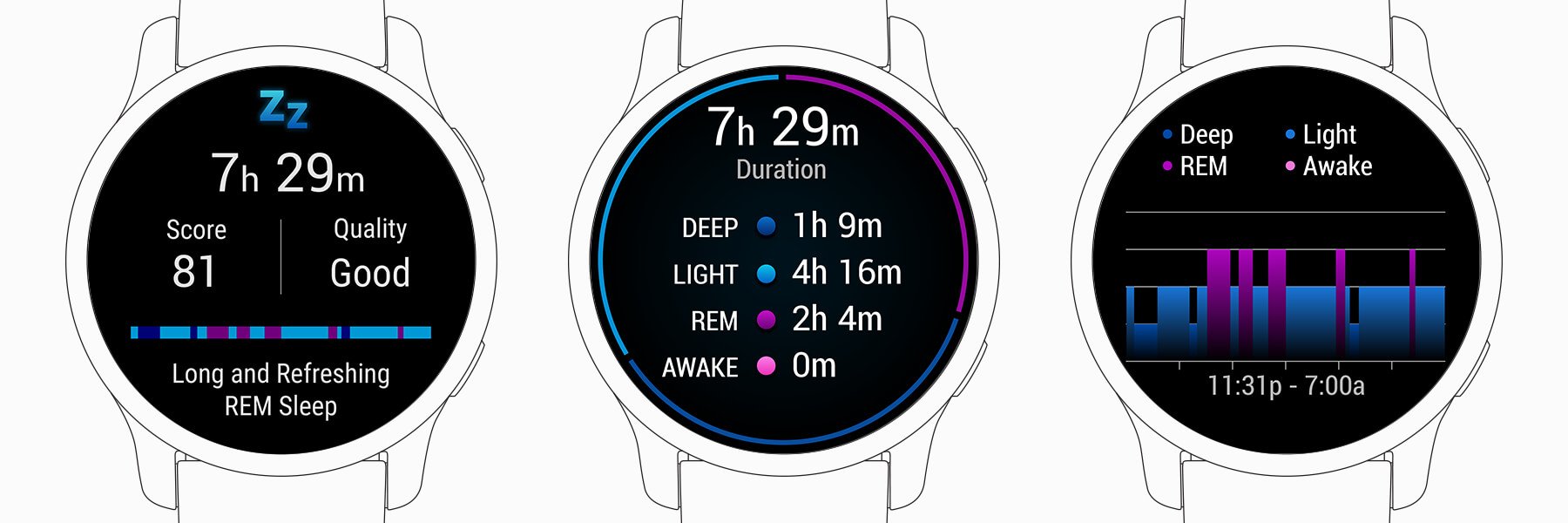
For sleep, Garmin Fenix 8 tracks all stages, scores your sleep on a 0–100 scale, and even includes a Sleep Coach that evaluates how much sleep you need. If you had a heavy workout the day before, it recommends more sleep. Or you can “make up” with a nap. :)
One of my favorite features is overnight heart rate variability (HRV). You get a graph of your HRV across the night, including min, max and average. If you want to dive deeper into HRV, see the article below.
HRV’s importance is underscored by the fact that virtually every smartwatch maker has implemented it over the past year.
In terms of workout analysis, you’ll see all the essentials on time, pace, heart rate, elevation gain, etc. It’s all averaged, complemented by charts, and you get training load analysis, VO2 Max estimates, recovery time and also Training Status, which reflects how well your training zones are distributed.

8.4.2021
What is VO2 max?
Whenever I review a Garmin, I can’t not mention “Training Readiness”, which takes into account your past activities, stress history, overnight HRV, sleep, recovery time, and rolls all of this into a 0–100 number expressing your ability to train that day.

If I had to highlight one more thing, it’s definitely running dynamics without any accessories. While you run, you get wrist‑based data like vertical oscillation, vertical ratio or ground contact time.
Garmin also won users over with relatively recent features that rate your Hill Score and Endurance Score.
If you’re curious about all of Garmin’s training or racing features, check the articles below.
Garmin Fenix 8 also gained plenty of diving features, logging individual dives (duration, depth, etc.) into the Garmin Dive app. Garmin reserved advanced technical dive modes and higher water resistance for the Descent line, but the eighth‑gen Fenix covers most needs.
What I also enjoy are the advanced strength workouts — not for pumping iron, but for general strength and injury prevention for specific sports like track and field. We all love to run, but spending time on recovery and strength is harder. Garmin keeps an eye on both or helps you with them.
Let’s quickly recap the basics before we jump to the hottest bits.
Garmin Fenix 8 shows all notifications from your phone, and Android users can also use quick replies. As is standard for Fenix, all models have a music player with streaming support (you need a premium account) and contactless payments.

Now the important part. Yes, Garmin Fenix 8 has a built‑in speaker and microphone, so you can handle calls near your phone. But not only that — Garmin watches have two types of voice assistant: one manages your watch (you can save a location, start an activity, etc.), the other manages your phone. Sadly for those who don’t speak English well, neither assistant supports Czech.

What I find practical are voice memos. Sometimes you’ve got a thought and the quickest way is to dictate it.
Garmin has struggled with messaging for years — aside from Android quick replies, you really couldn’t do much. Their Garmin Messenger app partly solves this: as long as both sides have it installed, you can chat right from the watch.
Garmin has long attracted users with truly detailed maps. You get the whole of Europe preinstalled (TopoActive base map) on the watch, and you can add nearly any corner of the world. With Czech localization you also get a topographic voucher that makes the map background even more detailed — richer road and building labels, better contours and trail colors.

Garmin brought two novelties for route planning. The first is dynamic routing: you set how long you want your workout to be, and the watch gets you back on time even if you deviate from the route.
Personally I like Garmin Share more, which now lets you send another user a route, a waypoint or even a workout. You know the feeling when you’re standing at the bottom of a hill and your buddy asks, “So what are we running today?” Garmin Share spares you the exhaustive answer.
What’s the difference between Fenix 8 and Fenix E?
I won’t overanalyze it — you can think of Fenix E either as a stripped Fenix 8 or a Fenix 7 (47 mm) with a facelift. Fenix E has:
And it doesn’t have:
If you asked me whether this model is interesting, I wouldn’t know what to say. I haven’t had it in hand yet, and it seems more advantageous to buy the original Fenix or Epix PRO versions than pay for the Fenix E.
If you’re curious about differences between Fenix 7 PRO and Fenix 8, here’s my colleague Matěj’s article.
The following lines don’t stem from bias toward Garmin (even if I might be subconsciously) — the Garmin Fenix 8 is excellent. For once, Garmin decided not to pile on lifestyle or sports features and instead focused on weak spots, creating a Fenix that can compete with Apple and Samsung. The new Fenix models are flattered by the AMOLED display paired with a UI that’s not only pretty but very snappy. The eighth generation also adds calling and a voice assistant.
These touches add up to a very compelling package, and I dare say the Fenix 8 is definitely poised to become the most successful Fenix yet. Do you agree?
Photo credits:


